Context
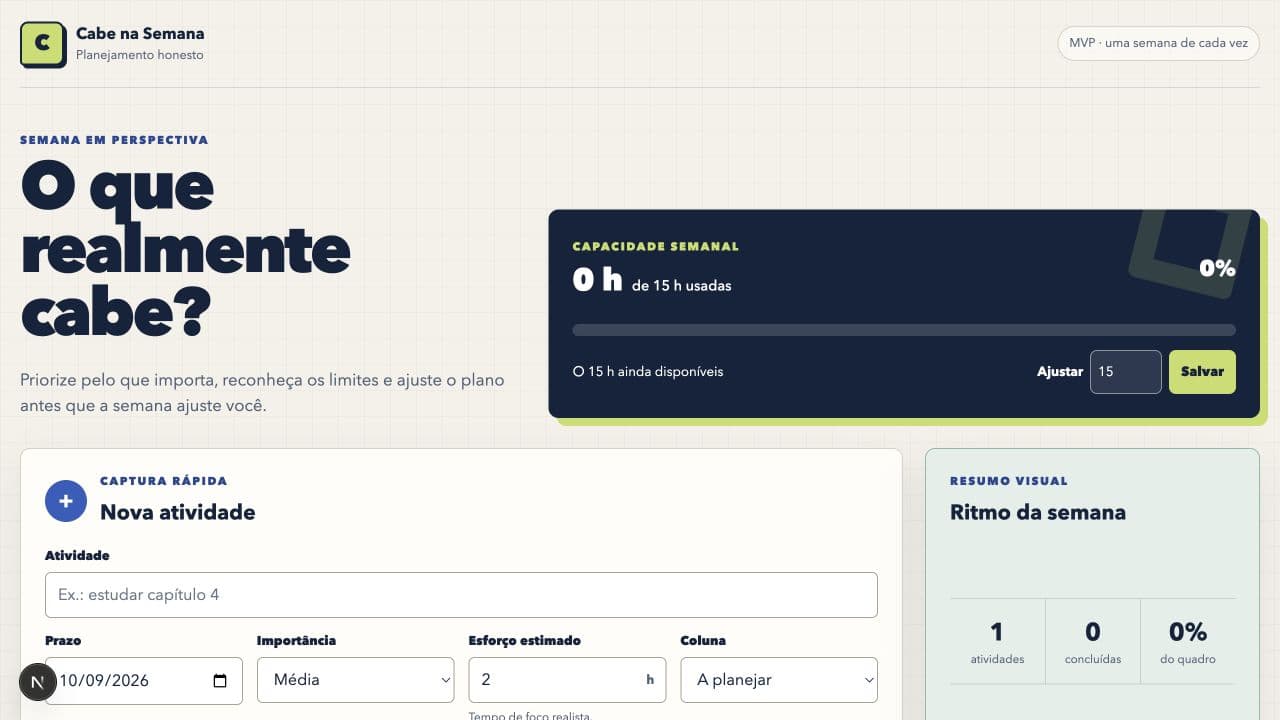
A task list alone does not show whether a plan fits the available time. I created Cabe na Semana to make that relationship visible: tasks have deadlines, importance, and estimated effort, while the week has an hour limit that should guide decisions.
My contribution
I developed the project end to end and migrated the MVP to ASP.NET Core and Next.js. I implemented priority and capacity rules, the persistence-backed API, and the board experience, including alternatives to dragging and feedback when a change fails.
How it works
- Each task receives a deadline, importance, estimated hours, and a board column.
- The domain calculates a priority score and explains the factors used in the classification.
- The plan compares this week's tasks and work in progress with configured capacity, indicating proximity to the limit or overflow.
- The board persists changes through the API and restores the previous position when an optimistic move cannot be saved.
Technical decisions
Explain priority
Classification combines deadlines, importance, and effort through deterministic rules. Showing the reasoning alongside the card helps people revise the plan without accepting an opaque ordering.
Offer multiple ways to move
The board combines mouse, touch, a keyboard sensor, and move buttons, with screen-reader announcements. Alternative controls use the same persistence and feedback flow.
What I learned
Small, explicit domain rules made the product easier to discuss and its boundaries easier to test. The most useful outcome was making each commitment's cost and priority understandable, rather than automating the choice.
Limits and next steps
- The MVP uses a shared board and configuration; it does not provide account isolation for multiple users.
- Estimates and scores support decisions; they do not constitute a productivity forecast.